Most Active UK Investors (April 2026 Edition): Angels Investors, VC Firms and CVCs
A monthly ranking based on Startupmag's tracking of active UK angel and venture capital investment.
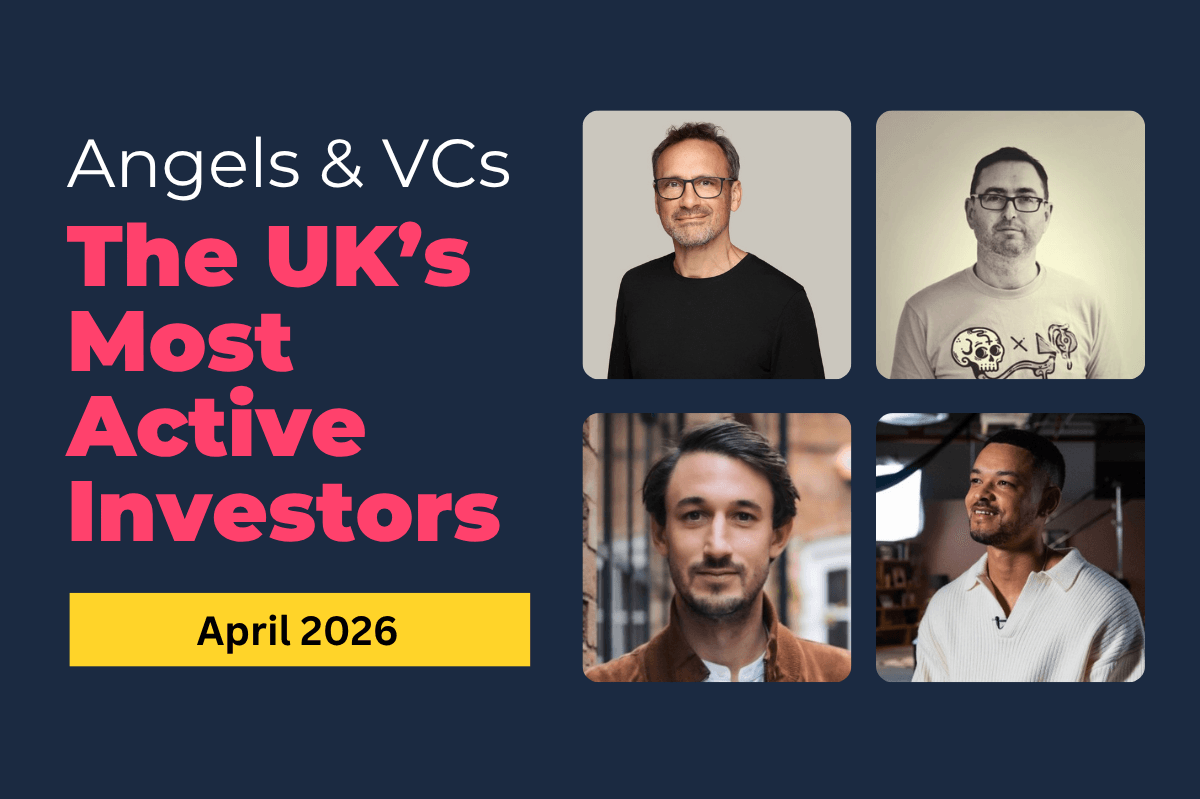

April 2026’s most active investors ranking reflects where UK capital was actually deployed in March 2026, spanning pre-seed, seed and growth rounds across angel investors, venture capital firms and corporate investment arms.
The analysis is based on Startupmag’s investor database, tracking live investment activity across thousands of UK angel investors, venture capital firms and strategic corporate investors.
Across angels, venture capital and corporate backers the month revealed a sector-focused and stage-differentiated market. AI and healthtech dominated early and mid-stage dealflow, while fintech, climate and industrial technologies formed a secondary but consistent pipeline. Angels concentrated on pre-seed and seed rounds, using operational experience to validate product and go-to-market risk. Venture firms provided the scaling ladder from seed through mid-stage growth. Corporate and bank-backed investors focused on larger, patient capital deployments into biotech, industrial energy, mobility and sustainability where strategic alignment and infrastructure scale matter most.
The pipeline showed strong activity in AI-led B2B SaaS, healthtech and biotech, alongside steady dealflow in fintech, proptech and climate-linked industrial technologies. Specialist regional programmes, university spinouts and co-investment structures continued to widen the early-stage funnel, while corporate and institutional investors concentrated capital into companies demonstrating clear technical defensibility and commercial pathways.
- Angels clustered at pre-seed and seed, typically within the £200k to £3m band, providing early validation, operator expertise and signalling power.
- VC firms formed the middle scaling layer, deploying capital from structured seed rounds through £3m to £15m growth allocations and selectively into £20m+ rounds.
- Corporate and bank-linked investors concentrated on strategic sectors such as biotech, energy and sustainability, supplying large capital alongside commercial deployment pathways.
These dynamics point to a constructive but increasingly specialised UK funding environment. Early experimentation remains strong, particularly around AI applications, but capital is flowing most efficiently toward companies demonstrating clear commercialisation routes, technical depth and scalability into international markets.
Angel investors: pre-seed and seed focus across sub-£1m–£3m round bands
Konstantin Vinogradov, Steven Bartlett, Gareth Williams, Tom Gozney, Hugo Rodger-Brown and Andy Gray were the most visible individual angels in March 2026. Their deal activity clustered around AI-led startups and adjacent HRtech plays, with a secondary theme of ecommerce and product-led consumer businesses. Several are operator angels and repeat founders, notably Gareth Williams and Tom Gozney, while Steven Bartlett stands out as a high-profile public figure and Konstantin represents a VC-affiliated angel. Taken together, these patterns show UK angels doubling down on AI and talent-facing tooling and using sector expertise to complement capital flows into early-stage rounds.
Each angel displayed a distinctive focus. Konstantin Vinogradov aligned with larger pre-seed enterprise AI, joining xmemory’s £3m round. Steven Bartlett backed AI upskilling at seed level with Ivee’s £745k round. Gareth Williams took a local, early-stage approach with SWURF’s £200k pre-seed, while Andy Gray focused on ecommerce tech examples such as Voxelo’s £650k pre-seed. Tom Gozney and Hugo Rodger-Brown backed product and creative SaaS and consumer opportunities around the £750k band, exemplified by Allday Goods (£765k) and First Concepts (£750k). All amounts cited are the total round sizes and do not represent individual cheque sizes.
There is a clear split in behaviour across these investors. Public-figure angels such as Steven Bartlett tend to join mid-sized seed rounds that attract attention and talent. Operator angels prefer sub-£1m deals where hands-on experience matters most, and VC-linked angels like Konstantin participate in larger pre-seed rounds that bridge startups to institutional capital. By participating in these round bands angels are de-risking early product and go-to-market work while creating a follow-on signal for VCs. For founders the message is simple: AI and HRtech remain high-momentum areas. Target angels whose operational experience matches your sector and structure rounds in the observed ticket bands.
Venture capital firms: £200k–£78.6m multi-stage cheques across AI, healthtech and industrials
| Venture Capital Firms | March Investments | Investment Sector | Location | Funding Round | Contact Details |
|---|---|---|---|---|---|
 Fuel Ventures(more info 🔒) Fuel Ventures is a venture capital firm that focuses on backing ambitious t... | Deaku (£480,000, Media) Flexzo AI (£9,000,000, Healthtech) Numonic (£250,000, AI) JAAQ (£13,000,000, Healthtech) instep.ai (£900,000, Proptech) |  London | |||
 SFC Capital(more info 🔒) SFC Capital is a venture capital firm that focuses on investing in early-st... | Plato (£260,000, Edtech) Hydra Manufacturing (£320,000, Material) Regeno (£420,000, Energy) Rivulo (£375,000, AI) | London | |||
Vuelo (£56,000,000, Fintech) Keith (£2,000,000, Legaltech) | London | ||||
Payr (£1,560,000, Fintech) VerbaFlo (£5,300,000, AI) | Stamford | ||||
Isembard (£37,000,000, Hardware) Tropic (£78,600,000, Agtech) | London, Cambridge |

Fuel Ventures and SFC Capital were the most active firms in March, with IQ Capital, BackedVC and Haatch also registering notable activity. The month was led by AI and healthtech, with solid deal flow across fintech, property and agricultural technology, advanced manufacturing and greentech. That breadth indicates a cross-sector appetite rather than a single hot theme. Specialist models and regional ecosystems were prominent: university spinouts, British Business Bank co-investment structures and public regional support featured across deals. Together, these flows point to a resilient UK venture market in which early-stage discovery in AI and healthtech is being backed by a widening ladder of follow-on capital, aligning with the strategic motives common to corporate investors such as industry adjacency, R&D alignment, regulatory or clinical focus and infrastructure-scale commitments.
Each investor demonstrated a distinctive pattern in March. Fuel Ventures ran a genuinely multi-stage book, pairing small pre-seed and seed checks such as Numonic (£250k), Deaku (£480k) and instep.ai (£900k) with larger growth rounds including Flexzo AI (£9m) and JAAQ (£13m). Its activity therefore spanned round-size bands from £200k–£800k through to £3m–£15m. SFC Capital concentrated on pre-seed bets, consistently backing university spinouts and industrial startups in the £200k–£800k band with Plato (£260k), Hydra Manufacturing (£320k), Regeno (£420k) and Rivulo (£375k). IQ Capital backed very large industrial and agtech rounds such as Isembard (£37m) and Tropic (£78.6m) in the £20m+ band. BackedVC bridged seed and growth with Keith (£2m; a round in the £0.5m–£2m band) and Vuelo (£56m, in the £20m+ band). Haatch pursued a seed-to-scale SaaS approach with Payr (£1.56m) and participation in the £3m–£15m VerbaFlo round.
The month highlights how early-stage, mid-stage and growth-stage approaches interlock to form a functioning ecosystem. Early-stage specialists and regional funds seed technical and commercial experiments, exemplified by SFC’s backing of university spinouts and Fuel’s pre-seed AI and proptech bets. Mid-stage investors then scale those experiments by focusing on product-market fit and revenue growth, as demonstrated by Haatch and BackedVC. Growth capital from deep tech-focused firms such as IQ Capital, together with large rounds led by sector specialists, provides the final leg for industrialisation and international expansion—particularly in capital-intensive hardware, agtech and fintech. Mission-led programmes, co-investment platforms and venture studios help de-risk nascent projects and create repeatable teams that attract later-stage funding.
Corporate venture capital: patient strategic cheques in biotech, industrial energy and agtech
| Corporate Venture Capital Firms | March Investments | Investment Sector | Location | Funding Round | Contact Details |
|---|---|---|---|---|---|
Bioliberty (£7,600,000, Healthtech) | Edinburgh | ||||
Diligent AI (£1,900,000, Regtech) | |||||
Tropic (£78,600,000, Agtech) | Amsterdam, Netherlands | ||||
Oxa (£77,000,000, Mobility) | |||||
Mestag Therapeutics (£30,000,000, Biotech) | NY, US | ||||
Nscale (£1,500,000,000, AI) |





March’s corporate-backed activity was led by a mix of established CVCs and pragmatic banks. ABN AMRO’s Sustainable Impact Fund, bp Ventures and Johnson & Johnson Innovation (JJDC) sat alongside the Scottish National Investment Bank and challenger bank investor N26. Funding clustered into three clear sectors: biotech and healthtech (Mestag, Bioliberty), industrial energy and mobility (Oxa), and sustainability-led agtech plus fintech/regtech (Tropic, Diligent AI). The presence of banks as active, strategic investors reinforces that non-traditional corporate vehicles are now core players, with moves focused on protecting R&D, backing industrial adjacency and underwriting commercial scale-up.
Distinctive deal-band patterns are visible across the market. JJDC continued to deploy into the upper clinical and mid-stage bracket with Mestag Therapeutics’ £30.1m growth round to fund a Phase I programme and platform expansion, favouring scientific de-risking and regulatory readiness. At the patient-capital, large strategic tier ABN AMRO’s SIF backed Tropic’s £78.6m Series C to commercialise climate-resilient crops, while bp Ventures matched that deployment mindset in industry with Oxa’s £77m Series D first close to scale autonomous industrial mobility and energy infrastructure. At the other end, Scottish National Investment Bank wrote a growth cheque into Bioliberty’s £7.6m healthtech round and N26 occupied a seed and support tier with £1.9m for regtech Diligent AI, showing banks can be both catalytic seed investors and growth-stage backers.
Viewed comparatively, pharma CVCs like JJDC skew to early scientific bets that transition into mid-stage clinical programmes, while industrial corporates favour later-stage deployment of AI, robotics and mobility technologies where infrastructure and partnerships unlock value. Bank- and insurer-linked funds specialise in patient, impact-oriented growth tickets and can bridge working-capital or structured-finance needs for scale. Those layers, including laboratory validation, clinical de-risking, industrial piloting and structured bank financing, interact to create a pipeline where corporate capital both de-risks technologies and provides routes to market across the UK and Europe.
In March the UK revealed a layered ecosystem where a shared appetite for AI, healthtech and sustainability-orientated industrials intersects with distinct capital strategies that collectively de-risk innovation and enable scale. Operator angels are the hands-on engines of early product and talent de-risking, VCs provide a multi-stage ladder from discovery to growth across varied cheque sizes, and corporate and bank-linked funds supply patient, deployment-focused capital and routes to market for regulated or infrastructure-heavy propositions. These distinctions matter: founders improve their chances by aligning round size and investor expertise with the precise technical or commercial risk they are addressing and by structuring financings to signal clear follow-on intent. In practice this means relying on operator angels for early traction, engaging multi-stage VCs to validate growth, and treating corporate or mission-led capital as strategic fuel for clinical, industrial or scale-up phases.
Click here for a full list of 7,526+ startup investors in the UK